


This topic describes the concepts behind supplier items, master items, and the family tree structures that can be generated from each.
Park City Group applications are based on two types of items: The supplier item and the master item. This guide describes the concepts behind these item types, and outlines some of the practical benefits derived therein.
Supplier Items (SI)
A supplier item is the item that a supplier sells to its trading partners (retailers). The item as it is sold to retailers is called the Vendor Unit (VU), and is usually a case or other bundled set of an item. The supplier's descriptions make up the content of this information in Park City Group. Please note that the term "Supplier Item (SI)" is synonymous with the term "Provider Item (PI)" used elsewhere in Park City Group Systems.
Supplier Item Families
A supplier item family consists of the item as sold to the retailer, such as by case or by pallet, and the item as it is sold to the consumer, such as by 6-pack or individual can. The supplier provides all of the information in a supplier item family.
The item as it is sold to the consumer is termed the Consumer Unit (CU). If a supplier item family has more than one consumer unit, the consumer unit included in an export is the smallest quantity that is set in the service agreement under Default Sellable Units.
Master Items (MI)
Park City Group maintains collection of reference items that we call the Master Item Database. This database consists of item descriptions, UPCs, and hierarchy data such as shipping unit, retail unit, and inner-pack quantities. Master item information is consistent and standardized, and can include details that may be missing from a supplier's descriptions, such as brand and retail packaging.
The way each supplier enters product descriptions and item information tends to vary from supplier to supplier. When a retailer reviews exports sent from different suppliers, it can be difficult to determine if individual items are the same in terms of content, size, and retail unit quantities. To solve this problem, a master item can be set up as a reference, making uniform descriptions, sizes, and other information available for export to retailers and manufacturers.
Master Item Families
Master items are set up as an extended family structure, built from the smallest retail-selling unit, such as the can, to the vendor unit sold by the suppler, such as the case. This item family consists of all of the different ways an item is packaged. For example, an item can be packaged by the pallet, case, inner-pack, and individual item. As such, the UPC on an inner-pack (such as a 12-pack) is different from the UPC on an individual item (such as a can). Through the master item family, the range of UPCs and other information associated with an item can be provided.
A master item must be "linked" with a supplier item before the additional family tree information can be included. Linking can be performed internally by Park City Group or it can be performed by corporate owners or authorized users of a particular master item database.
When item family information is available and the retailer requests it, Park City Group includes this information within exports to the supplier's retailers. The exported family information is based on the way the supplier has packaged or bundled the item (as listed Park City Group). This means that item information is included for each level that is equal to or lower than that item in the family tree. For example, if the supplier item is a 12-pack and the next lower level is the can, only the 12-pack and can information will be included.
This information is provided in different fields within the item-record fields of a generic export.
VU and CU
Master item families consist of both vendor units and consumer units. Normally, the vendor unit (VU) in a supplier item is a "case" or any other pack for which the supplier sells their product. The consumer unit (CU) is normally the pack that is sold to the consumer.
When exporting master items, the essential item is the "each" or smallest sellable unit for the item. For example, a 12-pack of soda is normally sold as a 12-pack, but can be opened and sold by the can. The can is the "each" in this example.
Pack, inner-pack, and order shipping unit quantity (OSUQ)
Park City Group's Data Content Management Department uses a numbering system to identify the packs within an item. Each item is divided into the pack, inner-pack, and the order shipping unit quantity, and is written in the format 2/12/24.
The pack is the largest bundle of items within a vendor unit (such as a case). For example, a case of candy bars might contain 10 packs of individual bars.
The inner-pack is the next bundled-level within the vendor unit. Each box of candy bars could contain 25 bars (25 inner packs). An individual bar is the single or "each" in this example, and is generally the consumer unit.
The order shipping unit quantity (OSUQ) is the total number of consumer units within the vendor unit. A case of 10 boxes with 25 bars per box has an OSUQ of 250.
The example would be written as 10/25/250.
Beverage cases are a good example.
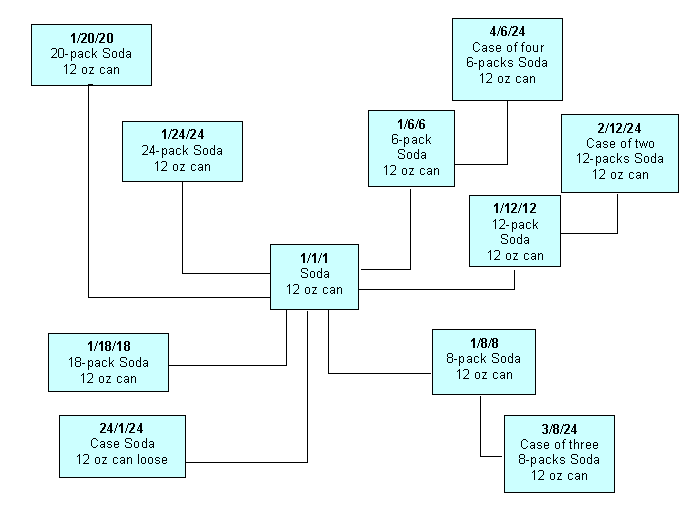
A case of two 12-packs is written as 2/12/24 to show that the vendor unit contains two packs of 12. Each pack contains an inner-pack of 12 units. The total number of units - the OSUQ - is 24.
Note that the normal sellable unit in this example is the 12-pack, but the inner-packs (the cans) could also be sold individually.
A case of four 6-packs is written as 4/6/24. (The case, the 6-packs, the cans.)
A single can is written as 1/1/1. The single can is the each, or smallest sellable unit. .
The following is an example of a typical beverage family tree.
Updated 7/18/2006 (vl to mi only)